Your Database Is the Real Performance Bottleneck — And It's Inflating Your Hosting Bill
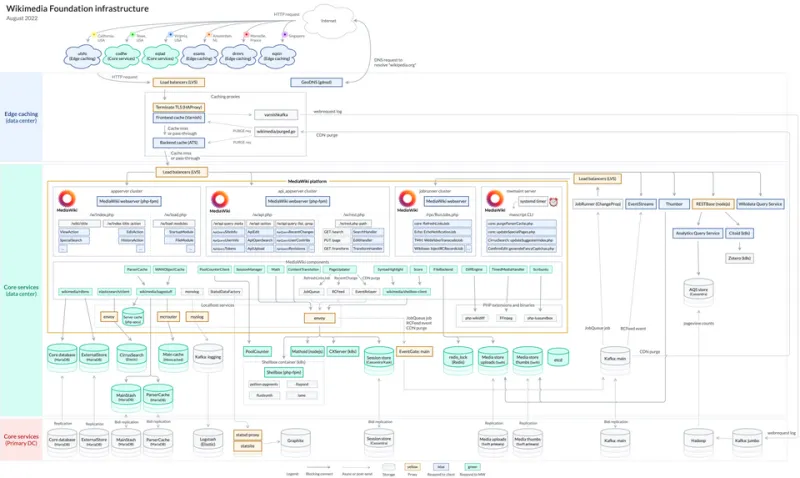
Photo: Timo Tijhof, CC0, via Wikimedia Commons
There is a widely accepted assumption in the world of web infrastructure: when your site slows down, you scale up. Upgrade the plan. Add more RAM. Move to a dedicated server. This logic feels intuitive, and hosting providers are generally happy to accommodate it. What rarely gets discussed is the underlying cause that makes that additional capacity necessary in the first place.
For a significant share of US businesses operating on dynamic web platforms — whether that is a mid-market e-commerce storefront, a SaaS application, or a content-heavy publishing site — the true source of latency is not the server tier. It is the database layer. Specifically, it is the accumulation of poorly structured queries, missing indexes, and inefficient data retrieval patterns that compound over time until the only apparent remedy is throwing more hardware at the problem.
This is what we at FastXWeb refer to as the latency tax: the measurable cost, both in infrastructure spending and in lost revenue, that businesses pay because of avoidable inefficiencies buried deep in their tech stacks.
Why Database Performance Is a Financial Issue, Not Just a Technical One
The connection between query performance and business outcomes is more direct than most operators realize. When a database takes 800 milliseconds to return results that should arrive in under 100 milliseconds, that delay cascades through every layer of the application. The web server holds the connection open longer. Concurrent users compete for the same resources. Response times spike. Bounce rates follow.
Research consistently shows that US consumers abandon slow-loading pages at rates that compound with each additional second of delay. For e-commerce businesses, that translates to measurable cart abandonment. For SaaS platforms, it contributes to churn. The revenue impact is real, even when it is never attributed to database inefficiency on any internal report.
Meanwhile, the infrastructure budget absorbs the cost of compensating. A business running on a $500-per-month dedicated server may genuinely need only a $150 virtual private server — if its queries were properly optimized. The difference is not a hosting problem. It is a code and architecture problem disguised as one.
The Most Common Sources of Hidden Query Waste
Understanding where latency waste originates requires looking at several common patterns that appear across a wide range of platforms.
N+1 query problems are among the most pervasive. This occurs when an application executes one query to retrieve a list of records, then executes an additional query for each individual record in that list. A page displaying 50 product reviews, for example, might trigger 51 database calls where a single well-structured query would suffice. At low traffic volumes, this goes unnoticed. Under load, it becomes a serious bottleneck.
Missing or misconfigured indexes are equally common. A database index functions similarly to the index at the back of a reference book — it allows the system to locate data without scanning every row in a table. Without appropriate indexes on frequently queried columns, even simple lookups become expensive full-table scans. As databases grow in size, the performance penalty grows with them.
Overfetching — retrieving far more data than the application actually needs — is another routine offender. Selecting all columns from a table when only two are required forces the database to read and transmit unnecessary data, consuming memory and bandwidth with every request.
Finally, unoptimized ORM-generated queries deserve attention. Many modern frameworks use object-relational mappers that abstract the database layer for developer convenience. That abstraction, while valuable, can produce verbose and inefficient SQL that no developer ever explicitly wrote or reviewed.
A Framework for Identifying Where the Latency Is Coming From
Diagnosing database performance problems does not require specialized expertise, but it does require deliberate instrumentation. The following framework provides a practical starting point for most business technology teams.
Step one: Enable slow query logging. Most major database systems — MySQL, PostgreSQL, MariaDB — offer built-in slow query logs that record any query exceeding a configurable execution threshold. Setting that threshold at 200 milliseconds and reviewing the log weekly will surface the most impactful offenders quickly.
Step two: Use EXPLAIN plans. The EXPLAIN command, available in virtually every relational database, reveals how the query engine is processing a given statement — including whether it is using indexes or performing full-table scans. This single tool provides more actionable insight than most commercial monitoring dashboards.
Step three: Audit query frequency, not just query duration. A query that takes 50 milliseconds but executes 10,000 times per hour contributes more total latency than a 500-millisecond query that runs twice a day. Application performance monitoring tools that surface query frequency alongside duration provide a more complete picture of where optimization effort should be focused.
Step four: Benchmark before and after every infrastructure change. If your team is considering a hosting upgrade, run a full query audit first. Establish a performance baseline, apply query-level optimizations, and measure the outcome. In many cases, the upgrade becomes unnecessary. In others, a smaller and less expensive tier upgrade proves sufficient.
The Compounding Effect on Customer Lifetime Value
Beyond the direct infrastructure cost, there is a subtler financial consequence that database latency inflicts on businesses over time. Customer lifetime value — the total revenue a business can expect from a single customer relationship — is meaningfully influenced by product experience. A platform that consistently responds slowly erodes user confidence and reduces engagement frequency.
For subscription-based businesses, this manifests as elevated churn. For e-commerce operators, it reduces repeat purchase rates. In both cases, the damage accumulates quietly, never appearing as a line item labeled "database inefficiency" in any revenue report.
The inverse is equally true. Businesses that invest in genuine performance optimization at the database layer — rather than masking the problem with additional server capacity — create a compounding advantage. Faster response times improve user retention. Better retention improves lifetime value. Improved lifetime value justifies acquisition investment. The financial logic is straightforward once the connection between database performance and business outcomes is made explicit.
Treating the Cause Rather Than the Symptom
The hosting industry's business model is, understandably, oriented toward selling capacity. There is nothing inherently wrong with that. But businesses that rely on capacity upgrades as a substitute for application-layer optimization are paying a premium for a solution that treats symptoms rather than causes.
A well-optimized database layer is not a luxury reserved for enterprise-scale organizations. It is a foundational investment that pays dividends across infrastructure costs, user experience, and long-term revenue performance. The tools to identify and resolve query inefficiencies are broadly available, often built directly into the database systems businesses are already running.
The latency tax is real, and most businesses are paying it. The question is whether they recognize it for what it is.